
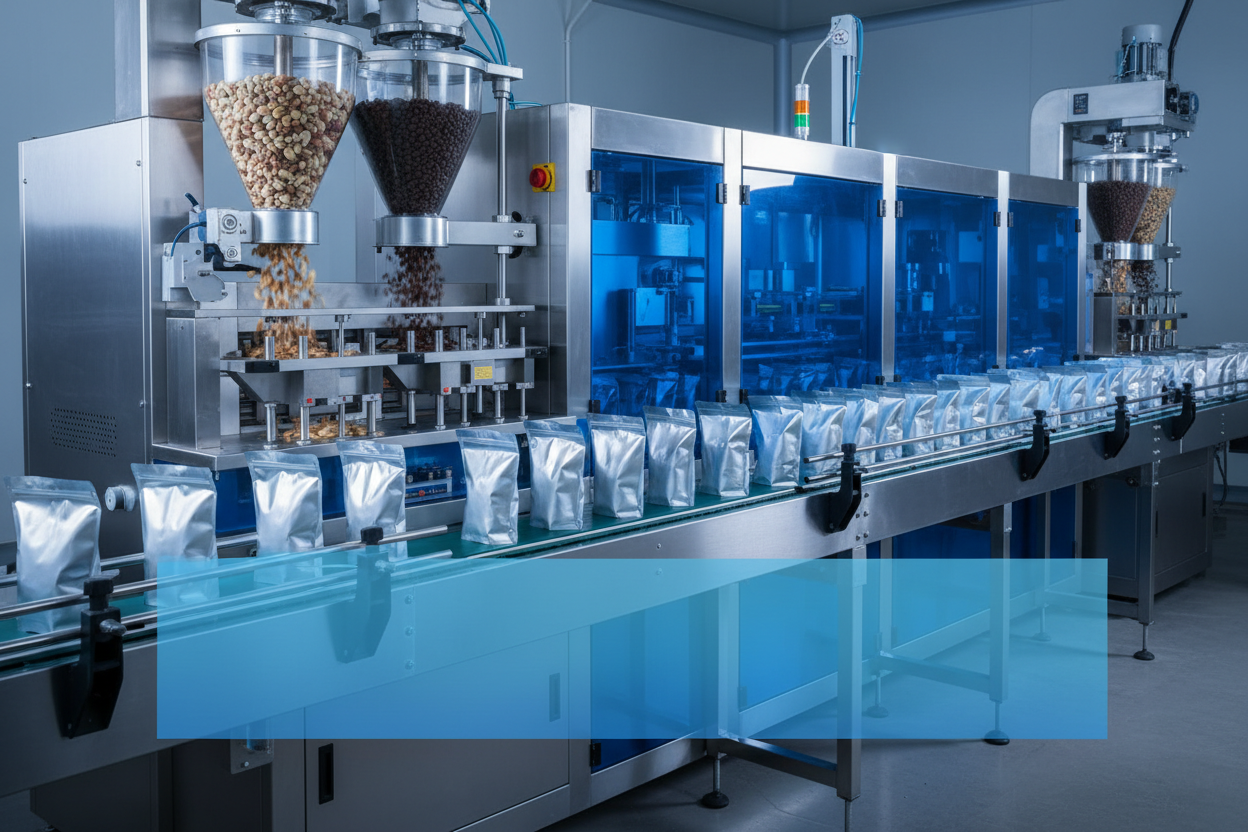
Premade Pouch Packaging Machine Buying Guide for Food and Granule Products
Premade Pouch Packaging Machine Buying Guide for Food and Granule Products
If you are evaluating a premade pouch packaging machine for your food or granule production line, this guide is written for procurement engineers, plant managers, and operations teams who need accurate technical benchmarks — not marketing language. We cover pouch compatibility, material suitability, throughput ranges, automation tiers, and the most common specification questions buyers ask before issuing an RFQ.
The global premade pouch packaging market continues to expand, driven by consumer preference for resealable, portion-controlled, and shelf-ready formats. For manufacturers in food, snack, pet food, nutraceutical, and industrial granule segments, premade pouch machines offer a compelling alternative to form-fill-seal systems when flexibility, changeover speed, and package presentation are priorities.
1. When Should You Choose a Premade Pouch Packaging Machine?
A premade pouch machine is the right choice when one or more of the following conditions apply to your operation:
- You require multiple pouch formats (stand-up, flat bottom, quad seal, spout pouch) on a single line without major mechanical rebuilds.
- Your product demands premium shelf presentation — premade pouches offer superior print registration and structural consistency compared to film-formed pouches.
- You need fast SKU changeover — typically under 30 minutes with tool-free jaw sets — to support short production runs or co-packing contracts.
- Your filling material is difficult to handle in a vertical form fill seal (VFFS) environment, such as sticky granules, irregular-shaped snacks, or products requiring nitrogen flushing.
- You are entering a new market or scaling a pilot line and need capital-efficient flexibility before committing to a dedicated VFFS configuration.
If your production volume exceeds 120 pouches per minute with a single SKU and standardized film, a VFFS system may offer a lower cost-per-pack. For all other scenarios, a premade pouch machine typically delivers a stronger ROI through reduced film waste, lower rejection rates, and faster time-to-market.
2. Compatible Pouch Types
Understanding pouch format compatibility is the first technical filter in any machine selection process. Most rotary premade pouch machines support the following formats:
Stand-Up Pouch (Doypack)
The most widely used format in food retail. Suitable for granules, powders, liquids, and semi-solids. Available with or without zipper reseal. Machines typically handle gusset widths from 30 mm to 120 mm.
Flat Bottom Pouch (Box Pouch / K-Seal)
Increasingly adopted in premium coffee, pet food, and snack categories. Offers superior shelf stability and a larger printable surface area. Requires machines with dedicated bottom-opening stations.
Quad Seal Side Gusset Pouch
Common in bulk granule, rice, and pet food applications. Provides high structural rigidity for heavier fill weights (500 g – 5 kg range).
Spout Pouch
Used for liquid, paste, and beverage applications. Requires a spout-insertion station and compatible filling nozzle configuration.
Three-Side Seal / Pillow Pouch
Suitable for single-serve snacks, sachets, and medical packaging. Lower material cost; less structural rigidity than stand-up formats.
Tip for buyers: Always confirm the machine's pouch width and length range against your full SKU portfolio — not just your current primary SKU. Future-proofing format compatibility reduces capital expenditure over a 5–8 year equipment lifecycle.
3. Applicable Materials and Product Types
Premade pouch machines are engineered to handle a broad range of filling materials. The key variables are flowability, particle size, bulk density, and hygroscopicity.
Free-Flowing Granules and Pellets
Products such as sugar, salt, coffee beans, pet kibble, plastic pellets, and fertilizer granules are well-suited to auger fillers or multi-head combination weighers integrated with premade pouch machines. Particle sizes from 1 mm to 30 mm are routinely handled.
Powders (Fine and Coarse)
Flour, protein powder, spices, and pharmaceutical powders require dust-control filling heads and, in many cases, nitrogen flushing capability to extend shelf life. Auger fillers with anti-bridging agitators are standard for cohesive powders.
Snacks and Irregular-Shaped Products
Chips, nuts, dried fruit, and confectionery require gentle handling to minimize breakage. Multi-head weighers (10-head to 32-head configurations) paired with premade pouch machines are the industry standard for this category.
Frozen and Chilled Products
Frozen vegetables, IQF seafood, and chilled ready meals can be packaged on premade pouch lines with stainless steel construction rated for washdown environments (IP65 or higher).
Liquids and Pastes
Sauces, condiments, juices, and dairy products require piston fillers or peristaltic pump systems. Spout pouch configurations are common for consumer liquid formats.
4. Speed Range and Throughput Benchmarks
Machine speed is one of the most frequently misquoted specifications in packaging equipment procurement. The following benchmarks reflect net production speeds under stable operating conditions — not theoretical maximums.
| Machine Type | Pouch Speed (pouches/min) | Typical Application |
|---|---|---|
| Entry-Level Rotary (4–6 station) | 20 – 40 | Pilot lines, co-packers, SME food producers |
| Mid-Range Rotary (8–10 station) | 40 – 80 | Regional food brands, contract packaging |
| High-Speed Rotary (12+ station) | 80 – 120 | Large-scale food manufacturers, FMCG lines |
| Linear Premade Pouch Machine | 15 – 35 | Heavy pouches, spout pouches, specialty formats |
Important note for buyers: Published speed ratings assume a single pouch size, optimized product flow, and no upstream/downstream bottlenecks. When integrating with a multi-head weigher, checkweigher, metal detector, and case packer, effective line OEE typically ranges from 75% to 88% depending on product characteristics and operator skill level.
5. Automation Levels: Matching Machine Intelligence to Your Operation
Automation level is a critical procurement decision that affects capital cost, labor requirements, changeover time, and long-term maintenance complexity.
Semi-Automatic Premade Pouch Machines
Operators manually load pouches into the magazine and may assist with sealing verification. Suitable for low-volume production (under 20 pouches/min), artisan food brands, or operations with high SKU variability and small batch sizes. Lower capital investment; higher per-unit labor cost.
Fully Automatic Premade Pouch Machines
Pouches are automatically separated, opened, filled, sealed, and discharged with minimal operator intervention. Servo-driven systems enable recipe-based changeover via HMI touchscreen. PLC-controlled with real-time fault diagnostics. Suitable for production volumes above 30 pouches/min.
Integrated Turnkey Packaging Lines
A complete end-to-end solution integrating the premade pouch machine with upstream weighing/filling equipment and downstream checkweighers, metal detectors, labelers, and case packers. Turnkey lines are engineered for maximum OEE and are the preferred configuration for food manufacturers targeting GMP, BRC, or SQF compliance.
Our packaging lines are designed with Industry 4.0 readiness in mind — including OPC-UA data connectivity, remote diagnostics, and MES integration capability — to support smart factory initiatives and real-time production monitoring.
6. Common Buyer Questions (FAQ)
Q: What is the minimum order quantity for premade pouches compatible with your machines?
A: Premade pouch machines are format-agnostic — they work with pouches supplied by any qualified pouch manufacturer. We recommend requesting pouch samples for FAT (Factory Acceptance Testing) validation before production launch.
Q: How long does a format changeover take?
A: On servo-driven rotary machines with tool-free jaw sets, changeover between pouch sizes typically takes 15–30 minutes. Machines with manual adjustment require 45–90 minutes. Changeover time is a key factor in calculating effective line utilization for multi-SKU operations.
Q: Can the machine handle nitrogen flushing for modified atmosphere packaging (MAP)?
A: Yes. Nitrogen flushing stations can be integrated into the rotary sequence for oxygen-sensitive products such as coffee, nuts, and snack foods. Residual oxygen levels below 1% are achievable with proper gas flush configuration.
Q: What certifications should I look for?
A: For food applications, look for CE marking (EU), UL/CSA (North America), and compliance with FDA 21 CFR Part 11 for electronic records if applicable. Machines intended for pharmaceutical or nutraceutical packaging should also meet GMP construction standards (316L stainless steel contact surfaces, no dead zones).
Q: What is the typical ROI timeline for a premade pouch packaging line?
A: ROI is highly dependent on production volume, labor cost reduction, and film waste savings. For operations replacing manual or semi-automatic packaging, payback periods of 18–36 months are common at production volumes above 40 pouches/min. We provide detailed ROI modeling as part of our pre-sales engineering consultation.
Q: How do I validate machine performance before shipment?
A: Factory Acceptance Testing (FAT) at the manufacturer's facility is standard practice. SAT (Site Acceptance Testing) is conducted after installation. Both should be defined in the purchase agreement with agreed KPIs including speed, seal integrity, and rejection rate thresholds.
7. Key Specifications Checklist for Your RFQ
When issuing a request for quotation for a premade pouch packaging machine, include the following parameters to receive accurate, comparable proposals:
- Pouch type(s) and dimensions (width × length × gusset depth)
- Fill weight range (minimum and maximum)
- Product description: flowability, particle size, bulk density, hygroscopicity
- Required production speed (pouches/min, net)
- Filling method preference (weigher, auger, piston, volumetric cup)
- Downstream integration requirements (checkweigher, metal detector, labeler, case packer)
- Facility utilities: voltage/frequency, compressed air supply, floor space constraints
- Regulatory and certification requirements (CE, UL, GMP, IP rating)
- FAT/SAT requirements and acceptance criteria
- Spare parts and after-sales service expectations
Conclusion: Selecting the Right Premade Pouch Packaging Machine
A premade pouch packaging machine is a strategic investment that directly impacts your production efficiency, product quality, and market competitiveness. The right machine selection depends on a precise match between your pouch formats, product characteristics, throughput requirements, and automation objectives — not on headline speed specifications alone.
As the packaging automation industry moves toward greater flexibility, data connectivity, and sustainability, premade pouch systems are increasingly positioned as the preferred format for food and granule manufacturers who need to respond quickly to market demands without sacrificing line efficiency.
We manufacture a full range of premade pouch packaging machines and turnkey packaging lines for food, granule, and industrial applications. Our engineering team provides format compatibility assessments, ROI modeling, and FAT/SAT support for every project.
📩 Send your pouch size and product details for a machine matching consultation — our team will respond within 24 hours with a technical recommendation tailored to your production requirements.
Why Are My Spice Products Clumping After Packaging? (And How to Actually Fix It)
Why Does Your VFFS Packaging Film Keep Misaligning? A Troubleshooting Guide
Related Posts

What Causes Weight Variation in Multihead Weighers?

How to Fill Coffee Powder, Milk Powder, and Protein Powder into Bottles

How Does Packaging Line Speed Affect Filling Accuracy and Product Waste?

5 Packaging Machine Mistakes That Cause Production Delays

How Do You Build a Packaging Line for Granule Products?

Before You Buy a Packaging Machine: 7 Things to Confirm

What Really Determines the Cost of an Automated Food Packaging Line?


